

The Peckham Experiment
Predating the NHS by a decade

I’m in Canada throughout July. So you get to see some of my random jottings which never made it into full articles on The Underground Map. I’m back in August when my inane scribblings take on a longer form once again.
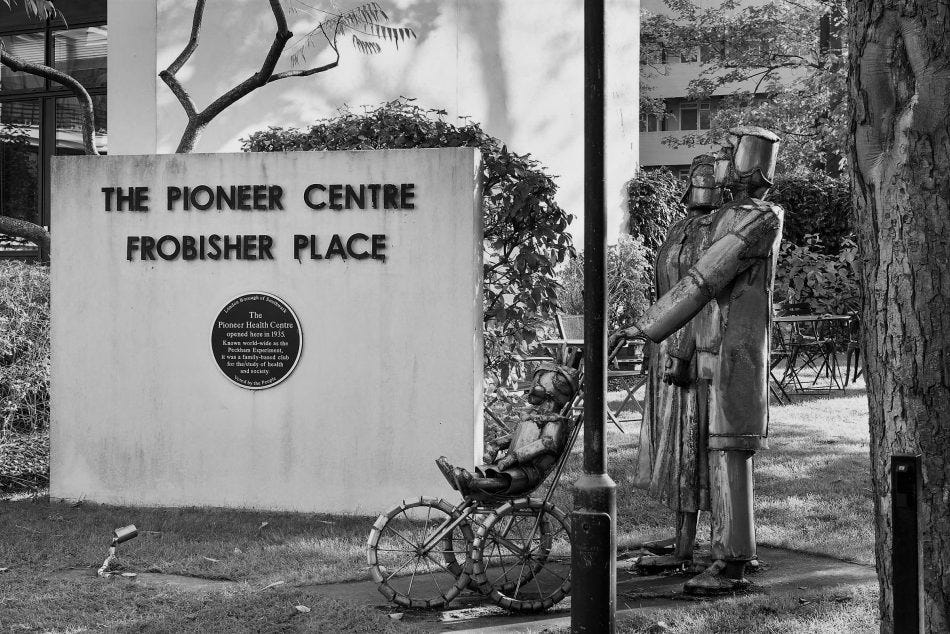
Walk down St Mary’s Road in Peckham today and you’ll find flats where, in 1935, one of the most radical social experiments in British health history began.
The Pioneer Health Centre - nicknamed the Peckham Experiment - was the brainchild of doctors George Scott Williamson and Innes Pearson. Their idea was startlingly simple, yet ahead of its time: rather than waiting for people to fall ill, why not study health itself? Local families paid a shilling a week to join, gaining access to a striking modernist building with a glass-walled swimming pool, gymnasium, nursery, and cafeteria, all wrapped around a central hall where members could simply be observed going about ordinary life.
It wasn’t a clinic. It was a living laboratory - part social club, part health survey and part architectural statement. Children played, parents socialised, and doctors quietly logged patterns of wellbeing rather than disease. The project anticipated ideas about preventative medicine and community health that wouldn’t become mainstream for decades.
The Second World War forced its closure, and it never fully reopened. The building still stands, now converted to housing, a quiet architectural clue to Peckham’s unexpectedly experimental past.
Thank you. This truly medical model is further reflected in the 1948 World Health Organization (WHO) definition of health, defining health as "a state of complete physical, mental, and social well-being, rather than just the absence of disease or infirmity". Many of the precepts continue in places such as the Bromley by Bow Centre and underpin the implementation of the Neighbourhood Health framework (in England). Let's see what happens.