

London’s Forgotten Tsar
Beard-hater Peter the Great was a very naughty boy

There is a statue near to the Thames Path in Deptford that makes some people go “Blimey - what’s that all about?”. It stands beside the creek where the river meets the old dockyard, and it is one of the stranger monuments in London. The figure is two metres tall, dressed in naval uniform, holding a clay pipe with the casual authority of a man who owns everything he surveys. His head, inexplicably, is tiny - out of all proportion to his body. Beside him squats a second, much shorter figure, whose identity was disputed for years. The plaque says the statue is a gift from the Russian people, commemorating a visit made in 1698.
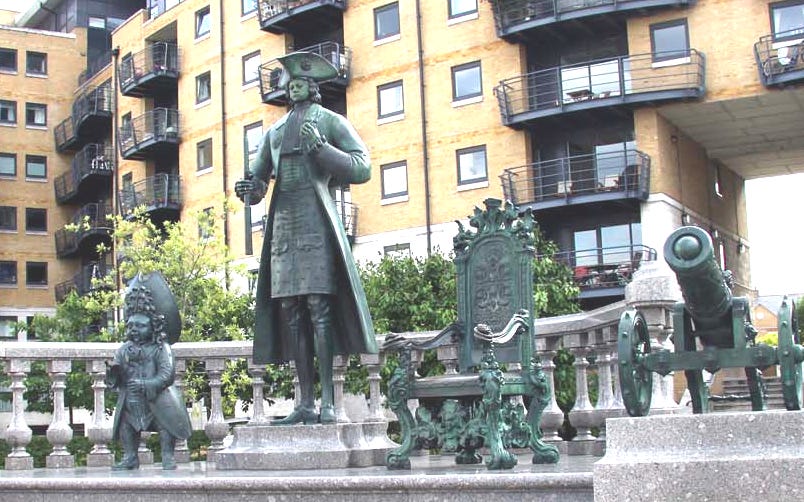
Most people who see it have no idea why there is a monument to a Russian tsar on a scruffy stretch of south-east London riverbank. Most people who live nearby couldn’t tell you much about what happened here three hundred and twenty-eight years ago, when Peter the Great arrived in Deptford for a stay that lasted 105 days and left one of London’s finest gardens in ruins.
The Tsar Who Came Incognito
Peter was twenty-five years old when he arrived in England in January 1698, and he was already, by some distance, the most physically remarkable man most Londoners had ever seen. He stood six feet eight inches tall in an era when the average sallow Londoner was five and a half feet. He travelled, officially, incognito - under the alias Peter Mikhailov, a minor Russian nobleman on a study tour - a fiction that required his entire retinue to maintain it with a straight face.
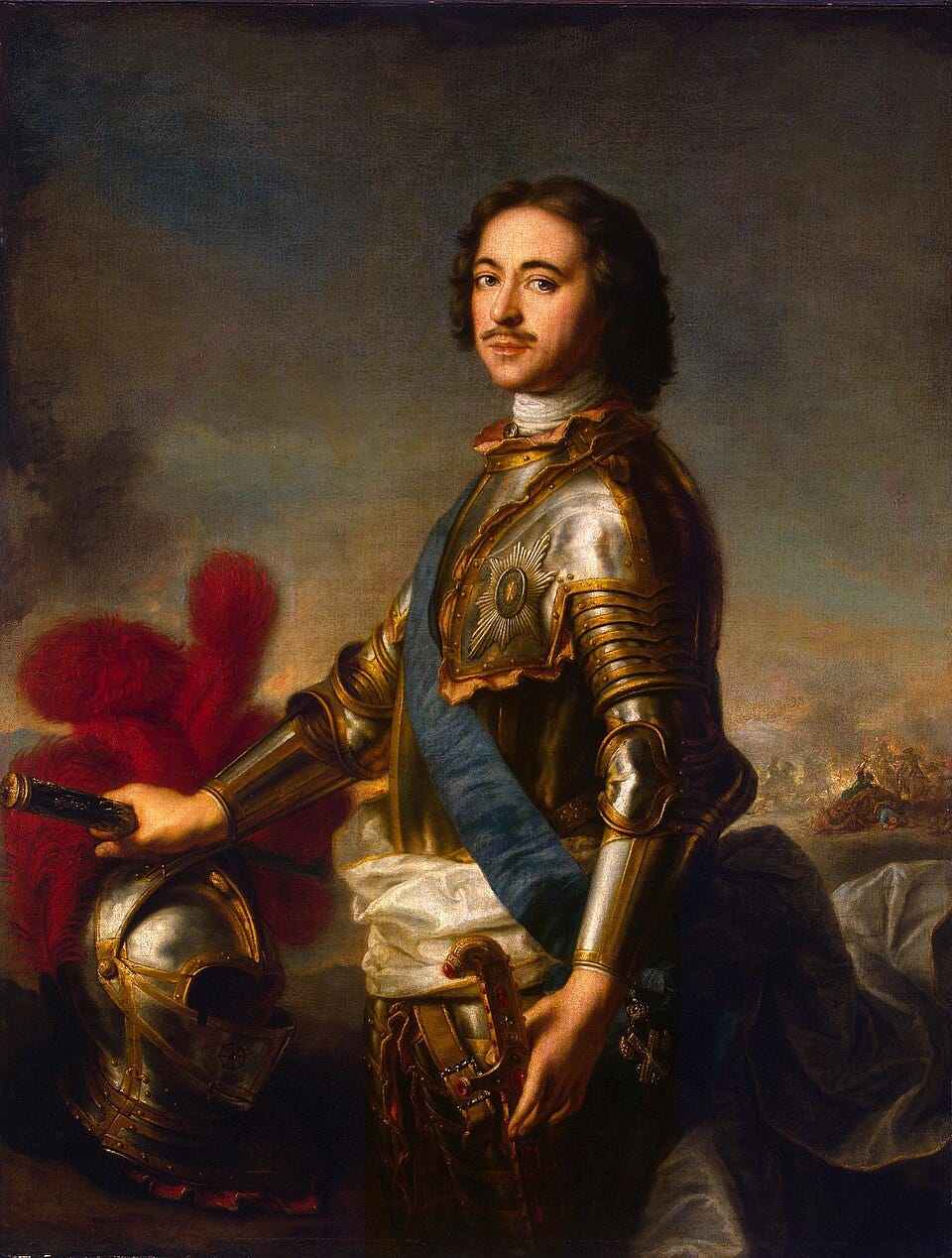
His entourage numbered several hundred people. It included four chamberlains, three interpreters, two clockmakers, a cook, a priest, six trumpeters, seventy soldiers (selected specifically because they were as tall as their master), four dwarves (quite the opposite), and a monkey. The Calendar of State Papers records, apparently without irony, that “The Czar is very much incognito here, and above all things desires to be so.” (The Calendar spelled him ‘Czar’ and I’ll spell him ‘Tsar’ just because I can).
Peter had come for a purpose. Russia in 1698 was a land power without a credible navy, and Peter had fixed on the construction of a modern fleet as the project that would transform his empire. The Dutch had the most sophisticated shipyards in Europe, and he had already spent time in Amsterdam learning their methods - only to discover, frustratingly, that the Dutch worked by instinct and tradition rather than written principles. They could not teach what they did not know how to explain. England was different. English shipbuilding ran on ‘art and science’, on technical drawings and documented methods. Peter wanted those methods, and he wanted them badly enough to cross Europe and sand timber himself to get them.
King William III - a Dutchman on the English throne, already keen to encourage trade with Russia - was delighted to help. He put the full apparatus of the English state at the Tsar’s disposal: access to the Royal Observatory, the Royal Mint, the Arsenal at Woolwich, the naval fleet at Portsmouth. He also arranged somewhere to stay.
The House in Deptford
The party landed at York House Watergate, the ornate riverside entrance just off what is now the Embankment, then still meeting the Thames directly. They installed themselves initially at a house on Norfolk Street. Then, in February, they moved to Deptford - to be next to the dockyards, which was the whole point.
The house was called Sayes Court. It belonged, technically, to John Evelyn, one of the great diarists of the age, a founder member of the Royal Society, and a man who had spent forty years creating what was considered one of the finest private gardens in England. The centrepiece of that garden was a holly hedge - four hundred feet long, nine feet high, five feet thick - on which Evelyn had lavished two decades of devoted attention.
Evelyn was not living there in 1698. He had leased it to a naval officer named Captain John Benbow, with strict conditions about maintaining the garden. Benbow, in turn, sub-let to the Russians when William III made clear it would be convenient. The first Evelyn heard of any of this was a letter from his steward, John Strickland, written in February: “There is a house full of people, and right nasty.”
105 Days
In the mornings, Peter went to the dockyard. He did not merely observe. A journeyman shipwright who worked there recalled in later years that “the Tsar of Muscovy worked with his own hands as hard as any man in the yard.” He had himself enrolled as a ship’s carpenter. He studied technical drawings, learned to read plans, acquired the vocabulary of English naval architecture in a foreign language. He was, by every account, an exceptional student - ferociously curious, physically tireless, and entirely uninterested in the social niceties that might have slowed a lesser visitor down.
In the afternoons and evenings, things were different.
Peter’s idea of leisure was vigorous. He visited the Royal Observatory at Greenwich, where he observed Venus through a telescope with the Astronomer Royal, John Flamsteed. He went to the Royal Mint at the Tower of London four times - where the Warden was one Isaac Newton, though whether they actually met in person remains unlikely, Newton apparently having sent Edmund Halley as his deputy on at least one occasion. He attended the Royal Society. He visited the Arsenal at Woolwich, Oxford, and the naval fleet at Portsmouth, where the English laid on a mock sea battle specially for his entertainment.
He also, at some point, went to a Quaker meeting house. This is perhaps the most unexpected detail in the whole visit. The Tsar of All the Russias, a man who would later deal with insubordinates using methods that made his contemporaries blanch, sat quietly through a Quaker meeting in Deptford and then another in Gracechurch Street, apparently genuinely curious about their theology. He discussed with William Penn and Thomas Story the Quaker position on military service. No record survives of what he concluded.
The encounters with Halley were more characteristic. Newton, it seems, found reasons not to attend on the Tsar personally, sending Halley - then famous as an astronomer and scientist, not yet immortalised by the comet that bears his name - in his place. Halley and Peter, by all accounts, got on extremely well. They bonded over science and brandy, in roughly equal measure. According to one account, one evening found both men comprehensively drunk in Deptford, at which point Halley commandeered a wheelbarrow and pushed the Tsar of All the Russias through the garden at speed.
Whether it was through Evelyn’s celebrated hedge is not recorded. It would not have mattered by then. The hedge was already gone.
The Damage
What Peter and his party did to Sayes Court over 105 days constitutes one of the most spectacular acts of houseguest vandalism in recorded history. The bill was eventually calculated by Sir Christopher Wren, in his capacity as royal surveyor, and came to £305 9s 6d - a very considerable sum. It is worth itemising, because the scale of destruction has a certain hallucinatory quality.
Every floor in the house was covered with grease and ink; three new floors had to be laid. All the tiled stoves, door locks, and paintwork had to be replaced. The curtains, quilts and bed linen were torn to pieces. Every one of the fifty-odd chairs in the house was either broken or had vanished - almost certainly burned on fires. Three hundred window panes were broken. Twenty paintings were torn from their frames, the frames broken, the canvases perforated - apparently used for target practice. The bill specifically itemises £3 for ‘wheelbarrows broke by the Tsar.’
Evelyn’s pride, his life’s work, the four-hundred-foot holly hedge, was destroyed. The Russians had discovered the wheelbarrows (which had not yet reached Russia, and were apparently a novelty) and devised an entertainment in which one member of the party sat in the barrow while another ran at maximum speed directly into the hedge. Judging by the final state of the hedge, the game was played many times, with great enthusiasm, by a large number of participants. Peter also knocked a hole through the garden wall to create a direct shortcut to the dockyard, which at least had a practical justification. The hole remained.
Peter departed on 21 April 1698, leaving behind a ruin. He also left behind, according to various accounts, somewhere between sixty and five hundred English craftsmen, engineers and specialists who had agreed to travel to Russia and enter his service - the human cargo he had actually come for. He gave his mistress, Letitia Cross, £500 as a parting gift. She told him it was not enough. He told her she was overpaid.
The Meetings That Never Happened
The strangest thread running through the whole visit is the gallery of encounters that almost were - the moments when the trajectory of history bent close and then curved away.
Peter walked through the Royal Observatory where Edmund Halley worked. He visited the Royal Mint four times while Isaac Newton was its Warden. He stayed in the house of John Evelyn, Fellow of the Royal Society, diarist, one of the most perceptive observers of his age. He passed within reach of Christopher Wren.
He met almost none of them. Evelyn never came to Sayes Court while the Russians were there, which - given what they were doing to it - was perhaps prudent, but meant that one of the great diarists of the century recorded nothing of the most remarkable visitor London had seen in a generation. Newton sent Halley instead of coming himself, and whether Peter and Newton ever stood in the same room remains unresolved. Wren only appeared after Peter had left, to add up the bill.
Five years later, when Newton became President of the Royal Society, he sent Peter a copy of the Principia Mathematica. It was a gesture across the distance that the visit had somehow failed to close.
What Happened Next
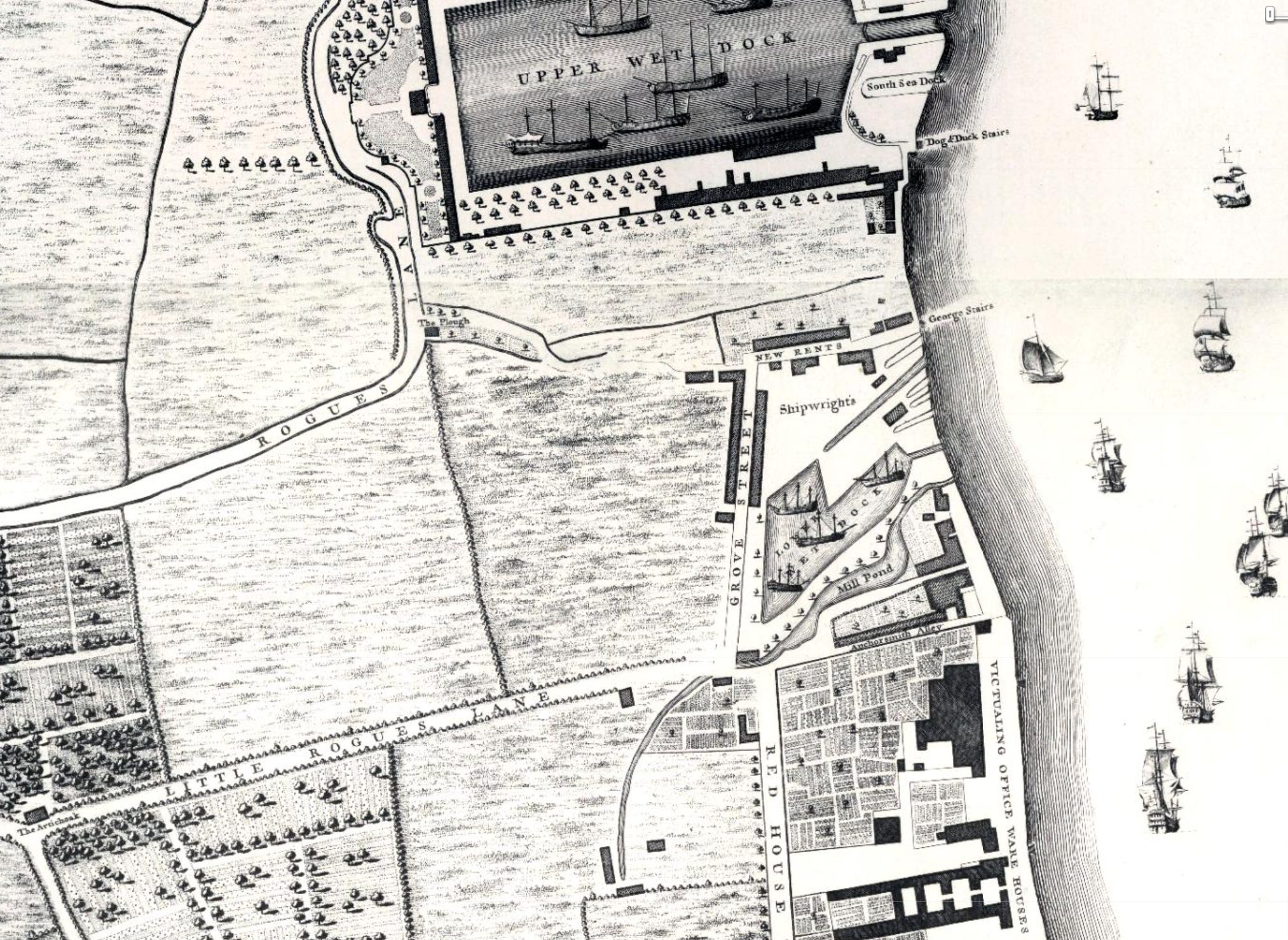
Sayes Court never recovered. After Evelyn’s death in 1706, the estate was broken up. The house passed through several hands and ended its days as a workhouse, which it remained until the 1840s. Then it was demolished. Where one of the finest private gardens in seventeenth-century England once stood, there is now a public park - Sayes Court Park - with a small plaque and a surviving mulberry tree of uncertain age. Nearby, as a further memorial, is Czar Street.
Peter went home and built a navy. He won the Great Northern War against Sweden. He built Saint Petersburg - a city conceived partly from what he had seen in London and Amsterdam - on a marsh at the mouth of the Neva, founding it formally in 1703. He forced his noblemen to shave their beards. He became, to history, Peter the Great.
The Deptford dockyard where he worked, which built some of the ships that defeated the Spanish Armada and launched the vessels of the East India Company, closed in 1869. It is now a leisure centre.
And the statue stands by the creek: tiny-headed, pipe in hand, the squat companion at his side. The companion, it turns out, is probably meant to be Evelyn - a small bronze figure of the man whose house Peter destroyed, placed for eternity beside the man who destroyed it. The original design, according to the Russian inscription on the plinth, called for several dwarves baring their buttocks. The final version is slightly more restrained.
Sayes Court Park is in Deptford, SE8, a short walk from Deptford Bridge DLR. The statue of Peter the Great stands on Glaisher Street at the confluence of Deptford Creek and the Thames. Czar Street is around the corner. The mulberry tree may or may not have been planted by Peter himself - but it has survived everything else, so perhaps it deserves the credit.
Not sure which is more extraordinary: Peter the Great and Edmund Halley getting drunk together and playing with wheelbarrows, or the idea that the wheelbarrow had not been discovered in Russia until the 18th century. Thanks for a charming story!
I knew Peter the Great had come to Deptford, but assumed it was on some sort of fact-finding factory visit. What an extraordinary story! Thanks for filling us in on the work/life balance - poor John Evelyn, but it sounds like Edmund Halley had a good time. 😊