It's better by Underground
Let's buy a ticket and go see a hanging

I’m away right now. So I’m running scheduled articles every Friday in July - a sort of The Underground Map lite
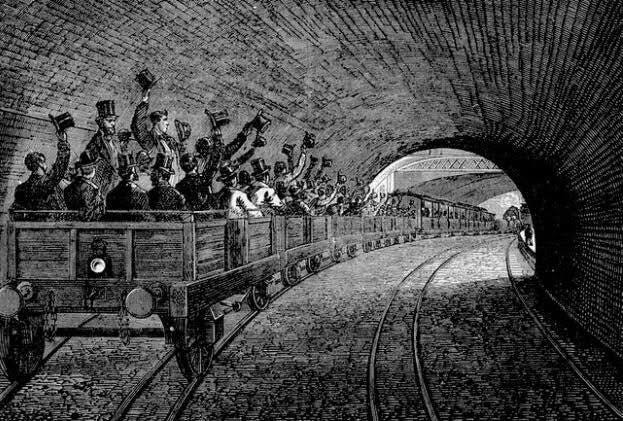
The very first Underground railway in the world opened on 10 January 1863. After that date, the Metropolitan Railway could take you from Paddington almost to the City of London.
While the London Underground since then has been a continuum, much distant historically from us here in 2026 was still in the future when the London Underground opened:
The American Civil War had 18 months left to run; slavery remained legal in the US until the 13th Amendment (Dec 1865). And Abraham Lincoln hadn’t yet given the Gettysburg Address (Nov 1863).
The Suez Canal didn’t exist yet (opened 1869).
Canada wasn’t yet a country (Confederation was 1867).
Karl Marx was still in the British Museum Reading Room writing Das Kapital (Vol. 1 published 1867) — he lived in London and could theoretically have ridden the new line.
Big Ben’s tower (now the Elizabeth Tower) was finished, but the Metropolitan Police hadn’t yet formed a detective force worth the name. Scotland Yard’s CID came later (1878).
The Fenian dynamite campaigns hadn’t started but would later specifically target the Underground itself (1883 bombings).
Dr Barnardo hadn’t yet opened his first home for destitute children (1867).
The Second Reform Act, which widened the franchise, was still four years off (1867).
Public executions outside Newgate were abolished in 1868 - but not before they had become one of London’s most popular spectator events, attracting crowds of 40 000. The last public hanging was of Michael Barrett. The campaign to abolish them was partly driven by the behaviour of the crowds, not sympathy for the condemned. So early Met Railway passengers really could have travelled to a public execution by Underground.